
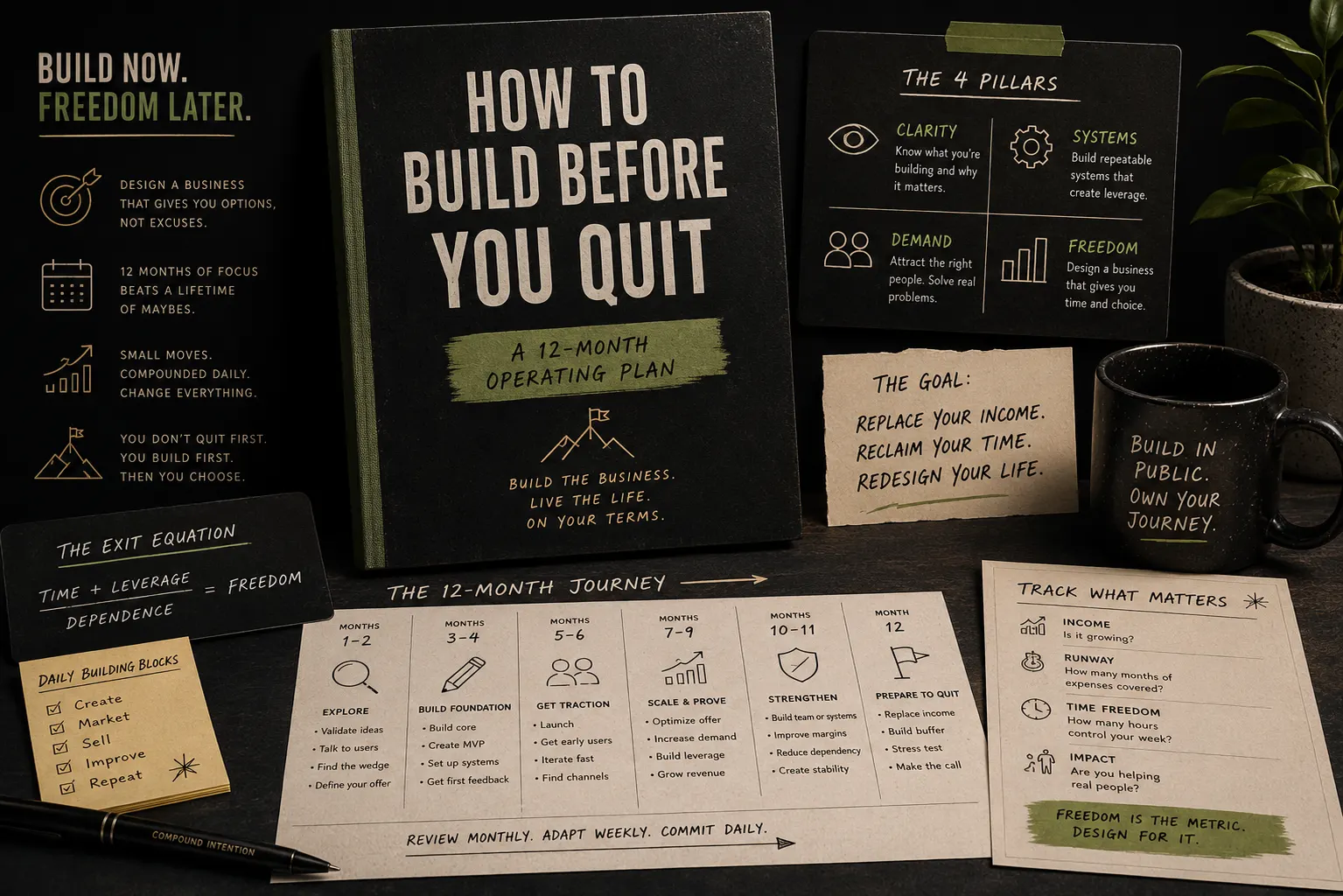
The best time to become a founder is not always the day you quit.
Often, it is the day you start operating like one.
A job can be a constraint. It can also be a funding source, training ground and risk buffer. The after-hours founder uses the job without letting the job own the future.
This is a 12-month plan for building before you quit.
It is not designed for fantasy. It is designed for evidence.
The goal is simple:
After 12 months, you should know whether the business deserves more of your life.Not whether you like the idea. Not whether friends are impressed. Whether the business has earned more time, capital and identity.
Month 1: Choose the arena
Do not choose an idea first.
Choose an arena.
An arena is a market space where you have some combination of:
- personal edge;
- visible demand;
- customer understanding;
- distribution access;
- willingness to work for years;
- ability to test quickly.
Examples:
- mobile utility apps;
- AI tools for real estate;
- paid search education;
- founder media;
- productized growth audits;
- templates for operators;
- YouTube packaging;
- app-store businesses;
- finance calculators;
- AI workflows for small teams.
Output:
One-page arena memo.Include:
- target customer;
- pain;
- existing alternatives;
- distribution channels;
- why you have an edge;
- first test ideas.
Month 2: Map demand
Study how the market expresses pain.
Use:
- Google Trends;
- search keywords;
- app-store search;
- Reddit;
- YouTube;
- reviews;
- marketplaces;
- competitor ads;
- forums;
- communities.
Google Trends can show relative interest across terms, regions and time. Google Ads can later turn that language into paid validation. Google’s own Quality Score documentation also reinforces why relevance between keyword, ad and landing page matters.
Output:
Demand map.Include:
- 30 keywords;
- 10 competitor examples;
- 10 user complaints;
- 5 landing page angles;
- 3 customer segments.
Month 3: Pick the smallest serious test
The first test should be small enough to ship and serious enough to teach.
Possible tests:
- landing page + waitlist;
- paid template;
- productized service;
- no-code prototype;
- manual concierge version;
- newsletter launch;
- paid search test;
- app-store concept test;
- YouTube/video experiment;
- directory MVP.
Output:
Test brief.Include:
- hypothesis;
- target audience;
- offer;
- landing page;
- conversion;
- budget;
- decision rule.
Example:
If we can generate 100 qualified signups below €7 each for an AI home design waitlist, we will build the MVP.Month 4: Ship the first public version
A public version changes the psychology.
It forces clarity.
Your first version should have:
- a clear promise;
- a page;
- a CTA;
- a way to capture demand;
- analytics;
- a feedback loop.
Do not overbuild.
The goal is not applause. It is market contact.
Output:
Live MVP or live validation page.Month 5: Talk to the market
Analytics show what people do. Conversations explain why.
Do 20 customer conversations.
Ask:
- What were you trying to solve?
- What have you tried before?
- What was frustrating?
- What would make this worth paying for?
- Where would you search for this?
- What alternatives do you compare it to?
- What would make you trust it?
- What would stop you from buying?
Output:
Customer language document.This document should feed copy, product, ads and content.
Month 6: Monetize something
By month 6, create a money signal.
It can be small.
Options:
- paid template;
- paid audit;
- pre-order;
- consulting package;
- paid beta;
- subscription MVP;
- sponsorship;
- affiliate revenue;
- small product purchase.
The goal is not revenue scale.
The goal is to cross the psychological line from interest to payment.
Output:
First revenue experiment.Track:
- visitors;
- leads;
- conversion;
- price;
- objections;
- fulfillment cost;
- gross margin;
- customer satisfaction.
Month 7: Build the operating system
If the idea has signal, stop relying on memory.
Create:
- weekly dashboard;
- experiment backlog;
- content calendar;
- customer feedback log;
- financial tracker;
- decision journal;
- task board;
- analytics review;
- monthly reset ritual.
A side business becomes serious when it has an operating rhythm.
Output:
Founder operating system v1.Month 8: Build distribution
Choose one primary channel.
Do not choose five.
Options:
- Google Search;
- SEO;
- YouTube;
- LinkedIn;
- Meta Ads;
- partnerships;
- cold outbound;
- communities;
- app-store search;
- newsletter swaps.
Your channel choice depends on the market.
If demand is explicit, search may work. If desire is visual, social may work. If trust matters, content may work. If buyer is specific, outbound may work.
Output:
Distribution thesis.Include:
- channel;
- reason;
- budget/time allocation;
- expected conversion path;
- content/ad assets;
- measurement plan.
Month 9: Improve the economic loop
Now ask:
Can this become a business?Study:
- customer acquisition cost;
- conversion rate;
- average order value;
- retention;
- refund/churn;
- delivery cost;
- support cost;
- payback;
- gross margin;
- time required.
Do not hide from bad numbers.
Bad numbers are useful if they tell you what to fix.
Output:
Unit economics memo.Month 10: Decide what to kill
By month 10, you should have too many ideas.
Kill most of them.
Kill:
- weak customer segments;
- bad channels;
- low-intent keywords;
- content that brings wrong readers;
- features nobody uses;
- offers nobody buys;
- workflows that drain energy;
- vanity metrics.
Focus is not a motivational concept. It is an operating decision.
Output:
Kill list.Month 11: Test full-time leverage
Before quitting, simulate full-time leverage.
Take one week off if possible.
Use it as a controlled experiment:
- ship more;
- run more sales calls;
- improve product;
- publish more;
- increase ad tests;
- respond faster;
- close deals;
- measure what changed.
Question:
Did more time materially improve the business?If not, time may not be the bottleneck.
Output:
Full-time leverage memo.Month 12: Make the decision
At the end of 12 months, choose one of four paths:
1. Quit
If evidence is strong, runway is sufficient and time is the bottleneck.
2. Keep building after work
If evidence is promising but not strong enough.
3. Pivot
If demand exists, but your current offer is wrong.
4. Kill
If the market is not responding and you are maintaining the project out of ego.
A mature founder can kill an idea without killing ambition.
The 12-month scoreboard
Track monthly:
Revenue
Leads/subscribers
Active users/customers
Experiments shipped
Conversion rate
Retention/repeat usage
Acquisition cost
Hours worked
Energy level
Key learning
Next decision
This scoreboard turns the year into a decision machine.
The founder lesson
You do not need to wait for permission to build.
But you also do not need to turn your life into a reckless founder movie.
Build first. Measure honestly. Protect your energy. Let the market teach you. Let the business earn more time.
The after-hours path is not slower by default.
It is simply less dramatic.
And for many founders, less drama is exactly what gives the business a chance to survive.
References
- Google Ads Quality Score help: https://support.google.com/google-ads/answer/6167118
- Google Ads landing page optimization guidance: https://support.google.com/google-ads/answer/6238826
- Google Trends: https://trends.google.com/trends/
- Y Combinator Startup Library — Advice for companies with less than 1 year of runway: https://www.ycombinator.com/library/3Z-advice-for-companies-with-less-than-1-year-of-runway