
A founder brand is easy to mock.
That is because many founder brands deserve it.
Too much performance. Too much borrowed wisdom. Too much posting. Too much “building in public” without much building. Too much personal mythology before the company has earned a story.
But dismissing founder brand entirely is lazy.
A serious founder brand is not fame.
It is a trust surface.
It helps the market understand who is building, why the company exists, what the founder notices, how decisions are made and whether the work has substance.
When done well, founder media becomes part of the company’s infrastructure.
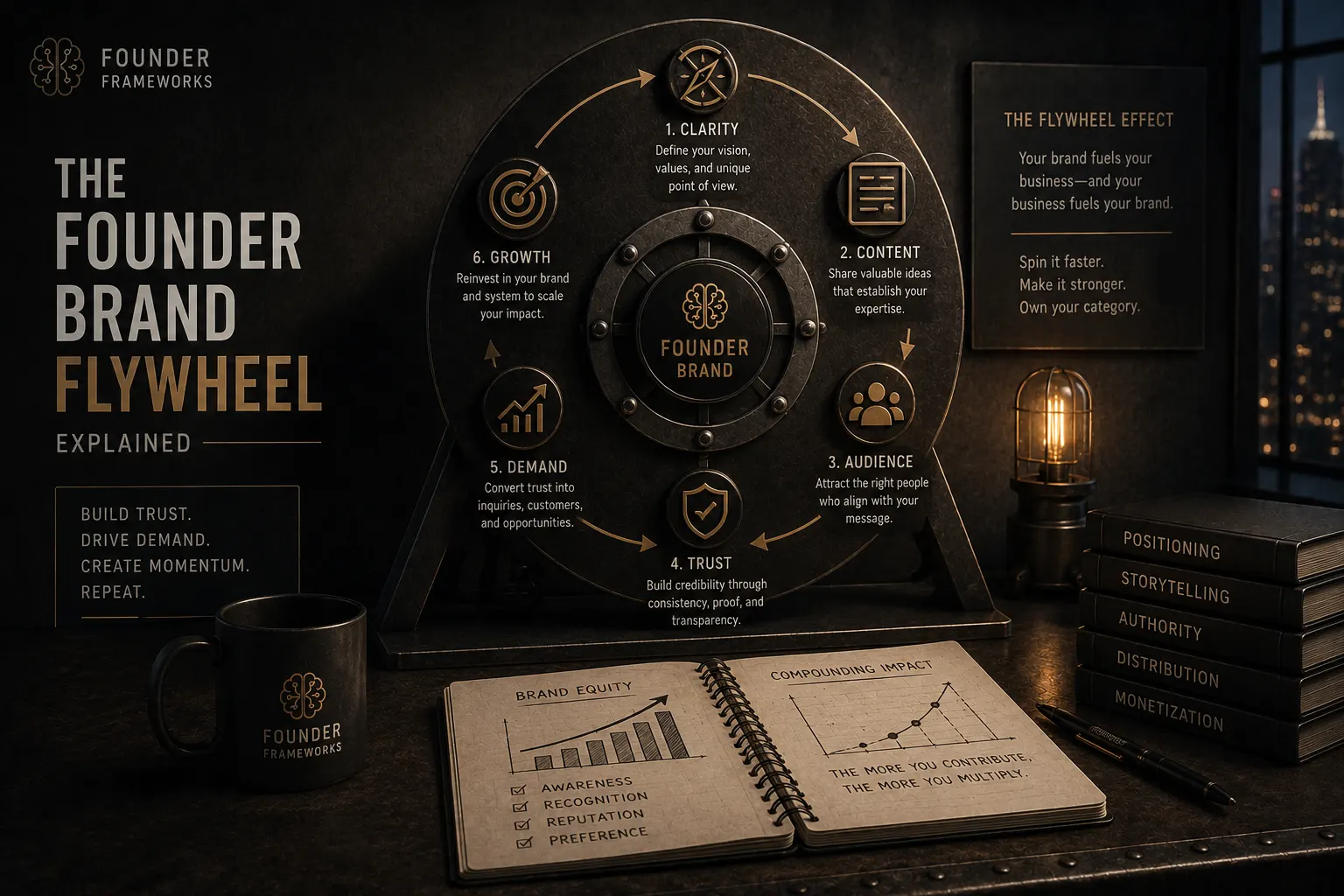
The flywheel
The founder brand flywheel has six steps:
Build → Document → Distribute → Attract → Convert → Compound1. Build
The first step is not content.
It is work worth documenting.
The founder must be making real decisions, running experiments, building products, hiring people, selling, measuring, failing and learning.
Without operating reality, content becomes theater.
2. Document
Documentation turns work into an asset.
A founder can document:
- decisions;
- mistakes;
- numbers;
- customer insights;
- hiring lessons;
- product experiments;
- company rituals;
- market observations;
- operating systems;
- personal trade-offs.
The strongest documentation is specific.
Weak:
Consistency is everything.Strong:
We killed this product after 42 days because paid search showed demand, but day-7 retention was too weak to justify more capital.Specificity creates trust.
3. Distribute
The content must travel.
Channels include:
- YouTube;
- LinkedIn;
- X;
- newsletters;
- podcasts;
- articles;
- founder communities;
- paid social;
- paid search;
- short-form clips;
- guest appearances.
YouTube’s own analytics documentation separates external traffic sources from other surfaces, which means founders can study whether viewers arrive from search, websites, social platforms or other external references. That matters because founder media can be engineered like a distribution system, not just posted randomly.
4. Attract
A founder brand attracts more than viewers.
It can attract:
- candidates;
- advisors;
- investors;
- customers;
- partners;
- journalists;
- other founders;
- creators;
- potential acquirers.
This is where the value becomes strategic.
The audience is not only an audience. It is a market map.
5. Convert
Trust must convert into business outcomes.
Possible conversions:
- email subscribers;
- job applicants;
- demo requests;
- investor intros;
- customer signups;
- YouTube subscribers;
- speaking invitations;
- partnership conversations;
- inbound acquisition interest.
The founder brand becomes valuable when it lowers the cost of one of these outcomes.
6. Compound
Over time, the content archive becomes a business asset.
A new candidate can understand the company before applying. An investor can study the founder’s thinking before a meeting. A customer can see the product philosophy. A partner can feel the seriousness of the operation. A viewer can become a subscriber, then a customer, then a collaborator.
That is the flywheel.
Why this is happening now
The creator economy has become a serious commercial channel. The IAB’s 2025 Creator Economy report projected U.S. creator ad spend at $37 billion in 2025 and noted that nearly half of creator ad buyers consider creators a “must buy.”
Founders are not traditional creators, but they benefit from the same shift: people trust people more easily than institutions, especially when the person shows judgment over time.
At the same time, companies are becoming more legible through media.
A founder can now explain the company directly, repeatedly and globally without waiting for press coverage.
This changes the power dynamic.
Old model:
Build company → wait for media attention → tell storyNew model:
Build company → become the media surface → shape the story as it developsThe difference between founder brand and personal fame
Personal fame asks:
How do I get attention?Founder brand asks:
How do I make the company, category and founder judgment more trusted over time?That distinction matters.
Attention without trust is fragile. Trust without distribution is underused. Distribution without substance becomes noise.
The best founder brands combine all three.
What founders should document
Use the OPN framework:
Operations
Point of view
Numbers
Operations
Show how things work.
Examples:
- weekly dashboard;
- hiring process;
- product sprint;
- customer support loop;
- creative testing system;
- AI agents workflow;
- company reset;
- decision memo.
Point of view
Say what you believe.
Examples:
- why boring businesses matter;
- why distribution beats product in some categories;
- why speed is cultural;
- why AI-native teams need stricter quality control;
- why founder media is becoming company infrastructure.
Numbers
Share numbers carefully.
Examples:
- revenue ranges;
- growth rates;
- payback periods;
- conversion rates;
- costs;
- lessons from experiments;
- unit economics.
Numbers create credibility. But they must be accurate, contextual and safe to share.
The anti-cringe rules
Founder media becomes cringe when it is too self-important.
Use these rules:
- Do not declare yourself a visionary.
- Do not post lessons from things you have not done.
- Do not turn every small decision into a universal truth.
- Do not confuse vulnerability with oversharing.
- Do not manufacture drama.
- Do not over-polish reality.
- Do not make the founder bigger than the company.
- Do not claim transparency while hiding the important parts.
- Do not post only wins.
- Do not let content replace operating.
The strongest founder brands feel earned.
The founder media scorecard
Score the brand from 1 to 5:
Substance: Is there a real business underneath?
Specificity: Are the details concrete?
Taste: Does it feel differentiated?
Consistency: Is there a repeatable cadence?
Usefulness: Does the audience learn something?
Trust: Does the content increase belief?
Conversion: Does it create business outcomes?
If substance is low, fix the business before scaling the content.
If consistency is low, create a production system.
If conversion is low, improve the funnel.
If trust is low, become more specific.
The founder lesson
A founder brand is not a shortcut.
It is a compounding layer on top of real work.
The formula is simple:
Real work + repeated documentation + strong taste + useful distribution = trust at scaleThat trust can become recruiting, capital, customers, audience, partnerships and category authority.
But the order matters.
Build first.
Then document.
Then let the flywheel turn.
References
- IAB Creator Economy Ad Spend & Strategy Report 2025: https://www.iab.com/insights/2025-creator-economy-ad-spend-strategy-report/
- YouTube Analytics traffic sources: https://support.google.com/youtube/answer/9314355
- Stripe Annual Update 2025: https://stripe.com/annual-updates/2025