
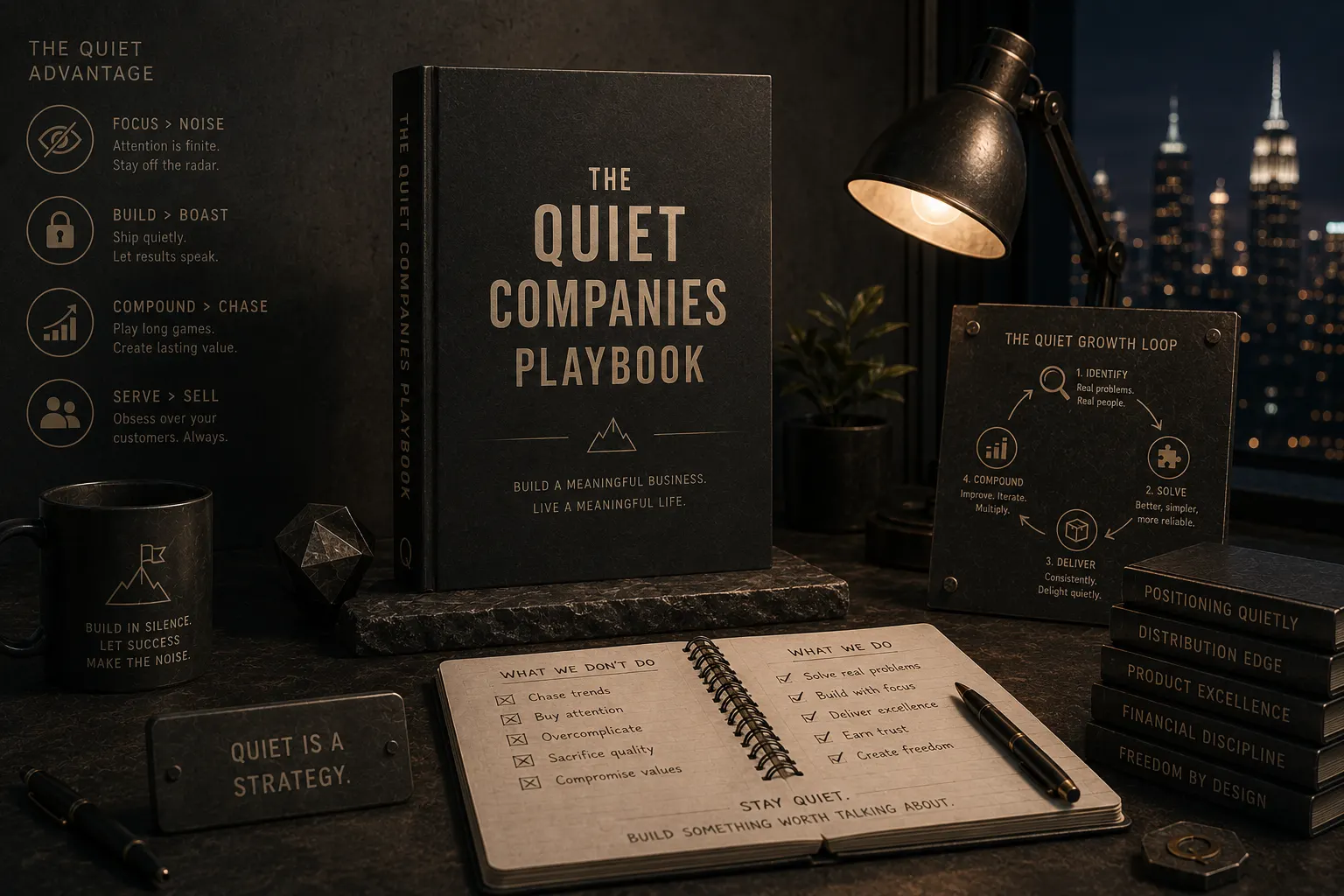
The internet over-rewards loud companies.
Funding announcements. Viral launches. Public founder drama. New categories. Big visions. Beautiful decks. Aggressive hiring. Hot markets.
Quiet companies rarely look that exciting.
They solve known problems. They sell into existing demand. They serve markets outsiders find boring. They grow through systems, not spectacle. They may never become cultural symbols, but they can become excellent businesses.
A quiet company is not a small company.
It is a company whose value is larger than its noise.
What makes a company quiet?
Quiet companies usually share a few traits:
- the problem is already understood;
- customers already pay for alternatives;
- the category may look boring from the outside;
- distribution is measurable;
- operations matter more than hype;
- retention or repeat purchase matters;
- the founder is not dependent on a trend narrative;
- progress is visible in numbers, not press.
Examples of quiet-company categories:
- document tools;
- accounting workflows;
- vertical software;
- compliance utilities;
- paid templates;
- local service software;
- consumer productivity apps;
- niche marketplaces;
- B2B services with software layers;
- specialized agencies;
- data products;
- calculators;
- infrastructure tools;
- subscription utilities.
These are not always easy. They are simply less theatrical.
Why boring demand is powerful
The best thing about boring demand is that it exists before you arrive.
A user searching for a scanner app already understands the job. A business looking for invoice approval software already understands the pain. A founder searching for a runway calculator already understands the decision.
You do not need to create the problem.
You need to be the better answer.
That changes the founder’s job.
Instead of evangelizing a new behavior, the founder competes on:
- speed;
- trust;
- price;
- UX;
- reliability;
- distribution;
- specificity;
- service;
- conversion;
- customer understanding.
This is less glamorous than category creation. It can also be more efficient.
Quiet does not mean easy
Boring markets are often competitive.
The reason is obvious: if demand is visible, other founders can see it too.
The advantage rarely comes from secrecy. It comes from operating better.
A quiet company wins by improving small things:
- a better landing page;
- clearer pricing;
- faster onboarding;
- better support;
- sharper paid search;
- stronger retention;
- more specific positioning;
- cleaner product experience;
- a better workflow;
- more trust;
- higher quality content;
- better internal dashboards.
None of these improvements are cinematic.
Together, they compound.
The quiet company stack
A modern quiet company usually has five layers.
1. Demand surface
Where does intent appear?
- Google Search;
- App Store search;
- marketplaces;
- review sites;
- communities;
- YouTube;
- newsletters;
- referrals;
- comparison pages.
2. Trust surface
Why should the customer believe?
- useful content;
- clear product pages;
- founder credibility;
- reviews;
- case studies;
- transparent pricing;
- good design;
- proof of expertise.
3. Product surface
How quickly does the user get value?
- onboarding;
- core workflow;
- templates;
- automation;
- support;
- integrations;
- output quality.
4. Economic surface
Does growth make sense?
- CAC;
- conversion;
- gross margin;
- retention;
- payback;
- churn;
- refund rate;
- support cost.
5. Operating surface
Can the company improve?
- dashboards;
- weekly reviews;
- experiment cadence;
- customer feedback;
- documentation;
- hiring;
- AI workflows;
- decision rules.
A quiet company is not just a product. It is a system of surfaces.
The app example
Consumer subscription apps are one of the clearest quiet-company categories.
Sensor Tower’s State of Mobile 2025 reported $150 billion in consumer app spend. RevenueCat’s 2026 report shows how different categories, access models and AI/non-AI segments vary across conversion, retention and refunds.
The lesson is not “build apps.”
The lesson is that quiet consumer problems can support large markets when the economic loop works.
Document scanning is not glamorous. Photo cleanup is not glamorous. PDF editing is not glamorous. AI room redesign is not glamorous in the same way a social network is glamorous.
But users understand the jobs.
That matters.
The SaaS example
In SaaS, quiet companies can look like:
- workflow tools;
- reporting dashboards;
- compliance software;
- data sync;
- niche CRMs;
- billing tools;
- customer support automation;
- internal operations products.
ChartMogul’s SaaS growth research has compared bootstrapped and VC-backed SaaS growth paths, showing that bootstrapped companies can still reach meaningful ARR milestones, though growth profiles differ.
The quiet-company lesson: not every good software business needs venture tempo.
Some need patience, niche clarity and durable retention.
How to find quiet-company opportunities
Look for:
1. High-intent searches
People searching for a specific solution.
Example:
send fax online2. Bad incumbents
Products with demand but poor UX, weak design or confusing pricing.
3. Manual workflows
People solving the problem through spreadsheets, agencies, email or repetitive labor.
4. Expensive services
A service that can become a product or productized workflow.
5. Regulated or annoying tasks
Problems people must solve, not just want to solve.
6. Repeated micro-pain
Small problems that happen often enough to justify payment.
7. Review-site complaints
Users telling you what incumbents do badly.
8. Category expansion
A known category changing because of AI, mobile behavior, platform shifts or new distribution.
The quiet-company test
Before building, ask:
Who already pays for this problem?
Where does demand appear?
Why are current options weak?
Can we improve one important thing by 10x or several things by 2x?
Can we reach buyers repeatedly?
Can this compound?
If you cannot answer where demand appears, the idea is not quiet. It is hidden.
Hidden ideas can work, but they require more education.
Quiet companies prefer demand that is already visible.
The founder lesson
A quiet company is not an unambitious company.
It is a company that does not need performance to be valuable.
It can grow in boring markets. It can compound through operational discipline. It can create wealth without cultural relevance. It can become loved by customers who simply need the job done.
The internet will continue to reward loud companies.
Founders should continue to study quiet ones.
That is where many of the best businesses hide.
References
- Stripe Annual Update 2025: https://stripe.com/annual-updates/2025
- Sensor Tower State of Mobile 2025: https://sensortower.com/state-of-mobile-2025
- RevenueCat State of Subscription Apps 2026: https://www.revenuecat.com/state-of-subscription-apps/
- ChartMogul SaaS Growth Report Bootstrapped vs VC-backed: https://chartmogul.com/reports/saas-growth-vc-bootstrapped/