
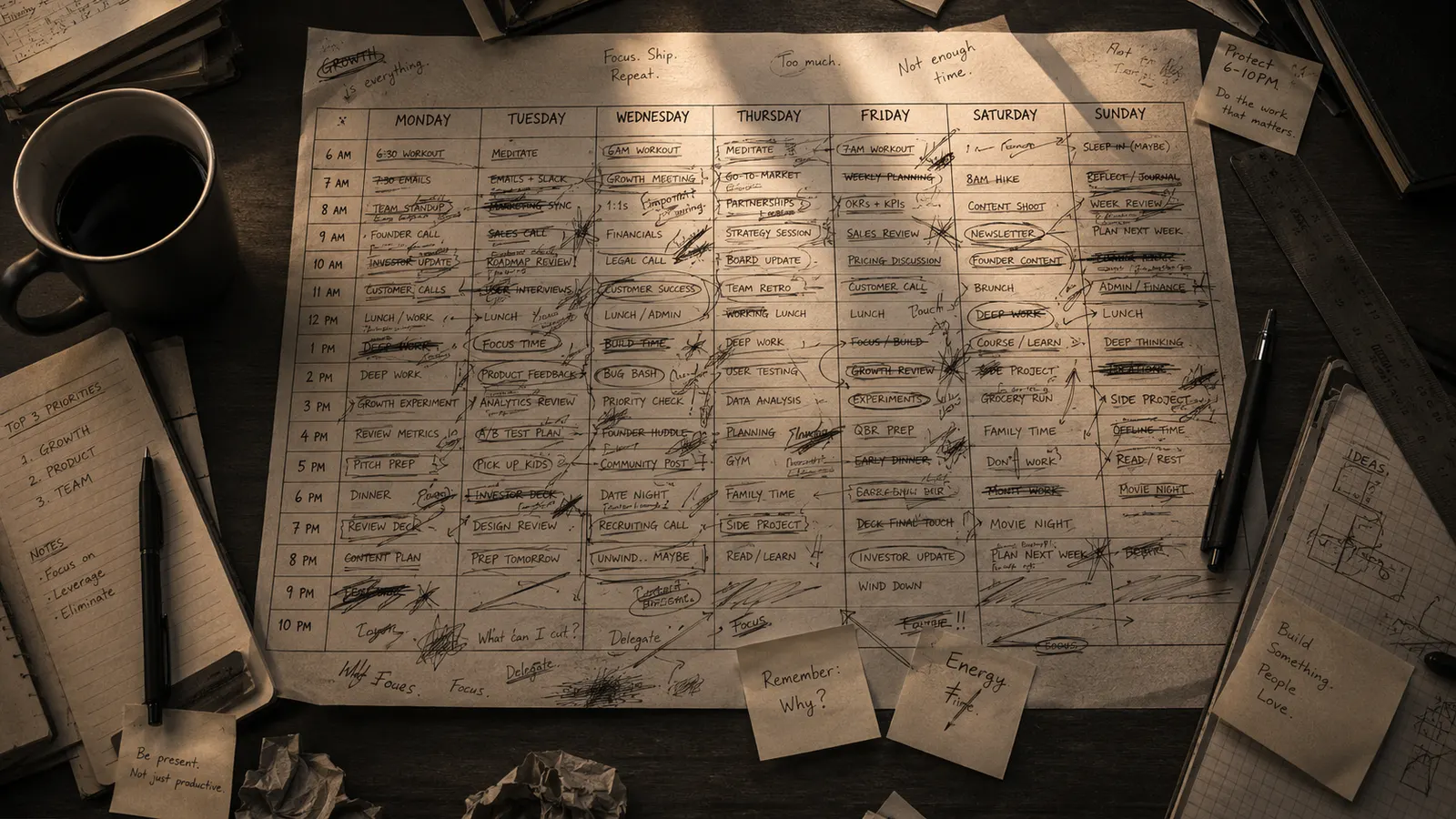
Most side businesses don't die from lack of time. They die because you spend your best hours on the wrong life.
For years I believed the problem was time.
I had a job at Google. Meetings, a manager, a pipeline, a Slack that never stopped. I also had a company I was quietly building on the side, and like everyone in that situation I told myself the same story: I just need more hours. If the day were longer, I'd build the real thing.
It took me an embarrassingly long time to admit the story was wrong. The day was already long enough. I wasn't short on time. I was spending the best version of myself on the wrong thing — and then asking the worst version of myself to build the thing that actually mattered.
I'd wake up rested, sharp, brave. And I'd hand that person to someone else's agenda. To the inbox. To a deck nobody would remember in a fortnight. By the time I sat down for my own company — pricing, product, the decisions that would decide whether any of it worked — I was running on fumes. Tired. Cautious. Cognitively broke.
Then I'd feel guilty and call it a discipline problem.
It wasn't a discipline problem. It was an allocation problem. I was asking my tired self to do my brave self's job.
I'll be honest about where the core idea comes from, because you'll respect it more: "manage your energy, not your time" isn't mine. Jim Loehr and Tony Schwartz built a body of work on it twenty years ago — their argument is that energy, not time, is what really drives performance, and they're right. What almost nobody talks about is what this does to you specifically when you're trying to become a founder while someone else is still signing your paycheck. That situation has its own trap, and this essay is about that trap.
The day is not flat
A calendar is a beautiful lie. It tells you 9am and 4pm are the same size — same box, same value, an hour is an hour. Your body knows this is nonsense.
Your 9am brain and your 4pm brain are not the same person. Your Monday-morning nerve and your Thursday-evening fatigue are not the same asset. There are windows where a hard strategic problem dissolves in twenty minutes, and windows where writing one clean email feels like carrying a sofa up the stairs alone.
This isn't woo. It's reasonably well mapped. Most people run on a daily rhythm Daniel Pink summarizes as peak, trough, and recovery — sharp in the morning, foggy in the early afternoon, oddly creative again in the evening — with the timing shifting depending on whether you're a lark or a night owl. The exact shape is yours.
It looks roughly like this — and I want to stress roughly, because the labels are mine and the timing is whatever yours turns out to be:
| Window | What it is | Best used for |
|---|---|---|
| Early morning | Peak clarity, highest nerve, zero residue | The one hard thing that moves your company |
| Mid-morning | Sharp but interruptible | Day-job deliverables; deep-ish work with a door open |
| Early afternoon | The trough — low analytical capacity | Admin, coordination, anything mechanical |
| Late afternoon | A second, smaller wind | Calls, reviews, reactive sprints |
| Evening | Depleted, avoidant | Recovery — or light execution, never decisions |
The point isn't to copy that grid. It's to study your own day with something close to cold detachment. When do you actually think best? When are you brave enough to make a real decision, and when do you go quietly avoidant? Which tasks drain you even when they're short? Which people give you energy, and which leave you flat for an hour after the call? What does email-first do to your morning, and what does starting with your own work do instead?
Most people have no idea. They react their way through the day, then wonder why the day owns them. The first move isn't optimization. It's awareness. You can't allocate an asset you've never measured.
Every task has two prices
We're trained to price tasks in time. A thirty-minute call. A one-hour meeting. But time is only the visible price. The hidden price is energy, and it's usually the one that decides your week.
Thirty minutes of writing strategy and a thirty-minute status call are not the same expense. A ten-minute conflict with someone on your team can cost you ten minutes on the calendar and two hours inside your nervous system. If you're an introvert in a sales role, every call carries a social tax — you can be good at it and still pay it. If you're analytical and your day is politics and alignment, that's a tax. If you're a builder and your best hours go to corporate theatre, that's a tax with the worst exchange rate of all.
The move isn't to avoid every draining task — that's not a job, that's a fantasy. The move is to place them on purpose. Some tasks need your genius. Most only need your competence. And a few are actually better when you're not at your peak, because they carry their own external energy: a call you can't escape will drag you upright when you'd otherwise drift; a repetitive task is fine late in the day, because it keeps you moving without asking your brain for anything it no longer has.
This is why my days, during certain stretches, ran from six in the morning to eleven at night without feeling like the death march it sounds like. Not because I'm a machine — I'm not. Because I wasn't doing one kind of work for seventeen hours. I was matching the task to the energy. Peak hours went to founder work: hard thinking, hard calls, product, distribution. Lower hours went to the work that only needed me awake.
There's research that should make you suspicious of long days, and you should keep it close. Stanford's John Pencavel found output per hour falls off a cliff after about fifty-five hours a week — past seventy, the extra hours produce essentially nothing. But that was measured on factory output, where every hour is the same kind of effort. The entire reason a long founder day can survive is that the hours are not the same kind of effort. The day Pencavel describes is uniform and exhausting. The day I'm describing is varied on purpose. The moment your long day becomes seventeen hours of uniform intensity, the research wins and you lose.
So the better question is never just what should I do today. It's: which version of me does this task require — and is that version available right now?
The one decision underneath all of it
Energy management is a nice idea until you make one uncomfortable decision. You have to decide what your number one actually is.
Not what sounds responsible. Not what plays well at dinner. Not what gives you the fastest hit of approval. Number one.
This took me far too long, and I know exactly why. Google is full of smart people grading your work in real time — managers, peers, reviews, calibration, the meeting where you were sharp or you weren't. If you have an ego, and most ambitious people do, that environment is a trap, because it pays you in validation on a same-day schedule.
Your side business does not do that. Early on, founding is silent. Nobody claps. Nobody checks whether you got up at six to think hard about retention. The market will care eventually — but not today, not at eleven o'clock when you need someone to tell you it mattered.
So the less important thing gets the better energy, purely because it has more visible judgment attached to it. That's the whole trick. You say your priority is the company. Your calendar says your priority is your employer. You say you want to be a founder, but your best cognitive hours go to corporate work and your business gets whatever's left after everyone else is satisfied. That is how people betray their own ambition without ever noticing — politely, professionally, on time.
Now, the part people expect me to say next is "so quit." I won't. For a lot of people, keeping a well-paid job while you build is the smartest possible move. It buys cash, stability, learning, network, and the thing nobody values until they've lost it — the ability to make decisions from strength instead of panic. Treated correctly, the salary is non-dilutive funding for your real company, and the job is a paid seat from which to study distribution, scale, and operations on someone else's balance sheet.
But if that's your strategy, be honest about the hierarchy. The salary is useful. The job is useful. The brand on your CV is useful. None of it is the centre. If your chosen identity is founder, the job is infrastructure. You can respect it without worshipping it. You can perform well without donating your best hours to it. You can be a professional without letting other people's approval set your priorities.
What you cannot do is have two number ones. The moment everything is number one, nothing is — and when nothing is clearly first, the world picks for you. It almost always picks the thing with the most meetings.
The system: best self first, then a fast 6
Once I accepted that founder was number one, the day designed itself.
The most important work went first. Not because mornings are magic — they aren't, for everyone — but because mornings were my highest-quality window, and there's a second reason that matters more than chronotype: in the morning there's no residue yet. Nobody has taken your mind hostage. No Slack thread has set the emotional weather. No meeting has convinced your nervous system that something urgent is happening. You're clean. And clean attention is one of the largest unfair advantages available to anyone building on the side.
That isn't just a feeling. Sophie Leroy's work on "attention residue" found that when you switch from one task to another, part of your mind stays stuck on the first one — and performance on the second suffers, especially when the first was left unfinished or emotionally charged. Your laptop changes tabs instantly. Your brain does not change identity instantly. If you spend the morning in corporate mode and then try to "switch" to founder mode, you're not switching — you're dragging the meeting in with you. Paul Graham made a related point years ago: makers and managers run on different schedules, and a single midday meeting can blow a maker's entire afternoon. Founder work is maker work. Protect the block, or the residue eats it.
This is why "I'll do it tonight" is so often a lie. Tonight isn't just later. Tonight is after residue — after meetings, after decisions, after food and stress and small disappointments and the emotional tax of being available to everyone all day. Your side business doesn't only need hours. It needs clean rooms inside your head.
That's what rituals are for — not romantic ones, operational ones. Same start time. Same first task. Same workspace if you can manage it. One rule above all the others:
No corporate input before founder output. Don't open Slack, email, or Teams until your first founder block is done. It's the cheapest way to keep the day's residue out of your single cleanest hour.
Then a shutdown ritual when you switch modes, and a clear definition of done for each block so the work can actually end. This is how ambition turns into architecture — and architecture beats motivation every time.
Inside each block, the system has two tools.
The first is timeboxing. Before you start, you decide how much the task deserves, and you stop when the box ends — not when it's perfect, not when your anxiety calms down, not when the imaginary judge in your head is finally satisfied. In my corporate years I'd routinely give two hours to a task that deserved thirty minutes — not because the work needed it, but because I'd never set the limit, so the task expanded to fill the day. (This has a name, Parkinson's Law, and once you've seen it you can't unsee it.) When I started asking "how much does this deserve, given my real priority?", something uncomfortable happened: the thirty-minute version often got the same feedback as the two-hour version. In a lot of corporate work, the gap between a 7 and a 10 is invisible — or visible and unrewarded. What gets rewarded is clarity, speed, presence, and doing enough of the right things consistently.
Which leads to the second tool, the one ambitious people hate: the 6/10 rule. Not everything in your life deserves your best work. I know — you want to be excellent everywhere. But excellence everywhere is just mediocrity at the thing that matters, dressed up as virtue. So you set standards by priority. Number one gets your best. Everything else gets professional, reliable, good-enough — a 6 or 7 where a 6 or 7 produces the identical real-world outcome as a 9.
Let me be precise, because this gets misread as "coast at your job." It's the opposite of coasting. Sloppy work creates debt — it damages trust and makes people chase you, which costs you far more energy than doing it right. The 6/10 rule isn't permission to be careless; it's a refusal to be miscalibrated. High standards on the things that compound — product, customers, hiring, cash, distribution. Calibrated standards on the internal artefact nobody will remember in two weeks. A 10 out of 10 on the wrong task isn't excellence. It's waste.
It helps to hold the whole day as a single portfolio, and to know what tier each hour belongs to:
| Tier | Your state | What it's for |
|---|---|---|
| Core | Peak clarity, highest nerve | The founder work that changes the trajectory — strategy, product, positioning, distribution, the hard call |
| Defensive | Steady, competent | Day-job deliverables, client calls, the one-on-ones where another person keeps you alert |
| Mechanical | Low drive, still functional | Admin, invoicing, follow-ups, updating metrics |
| Recovery | Depleted | Rest. Not fake work — there's no medal for typing while your brain is offline |
A founder cannot confuse movement with progress. Most people avoid the Core work because it's uncomfortable — it asks for judgment, it doesn't pay out in same-day dopamine — so they fill the day with easier things and call it productivity. Your best energy should not go to clearing notifications, or to being perceived as busy, or to maintaining the identity of a good employee if your real bet is becoming a great founder. You become dangerous not by working more hours, but by refusing to burn your best ones on things that don't move.
The audit — do this before you change anything
If you're building on the side, don't reorganize your life this week. Just watch it for two.
Every two or three hours, write down a number from 1 to 10 for your energy, and one line about what you were doing — and whether it gave energy or took it. Note what you ate, how you slept, whether you'd just come out of meetings, and what kind of work it was: deep, social, admin, creative, or decision-making. If three full check-ins a day is too much to sustain, shrink it: at 9am, 1pm, and 5pm, log three things — your clarity out of 10, whatever corporate problem is still looping in the background, and whether you're currently acting as the employee or the founder. The point is data, not a journaling habit.
After two weeks, the patterns show up, and they're rarely what you assumed. You might find your real strategy window is 7 to 10am and you've been spending it on email. You might find you're useless for deep work after lunch but genuinely good on calls. You might find that social calls drain you unless the other person has high energy. You might find that what you've been calling "lack of discipline" is a sleep problem wearing a costume. You might find your calendar was built for someone else's body.
Then, and only then, redesign:
- Number one priority into your number one window.
- Secondary work into secondary windows.
- Batch the reactive stuff.
- Timebox the corporate stuff.
- Protect one clean block of attention like it's the most valuable thing you own, because it is.
- Use unavoidable social obligations as energy when they help, and quarantine them when they don't.
- Decide, in advance, what deserves a 10, what deserves a 7, and what deserves a fast 6.
The real flex
The real flex was never "I work more than you."
It's knowing exactly when you're dangerous. When your thinking is sharp and your nerve is highest. When your body is lying to you. When a task is only pretending to be important. When perfectionism is just ego in a nicer outfit. When corporate validation is quietly stealing founder energy. And when to stop.
Somewhere in those years I stopped treating the day like a container to be filled and started treating it like a portfolio to be allocated. Some hours are blue-chip — your highest-yield asset, and you'd be insane to spend them clearing notifications. Some hours are defensive. Some are illiquid. And some are honestly junk. Invest them at random and you lose, no matter how many of them there are. Allocate them on purpose and the same day becomes a different day.
Same job. Same company. Same body. Same twenty-four hours. Different architecture. And architecture beats motivation every time.
That's the shift. You stop trying to find time and start directing energy. And here's the part nobody tells you: the side business doesn't become real the day you quit, or announce it, or the day the world finally approves.
It becomes real the first morning you give it your best self before anyone else can ask for it.
Everything else is infrastructure.